
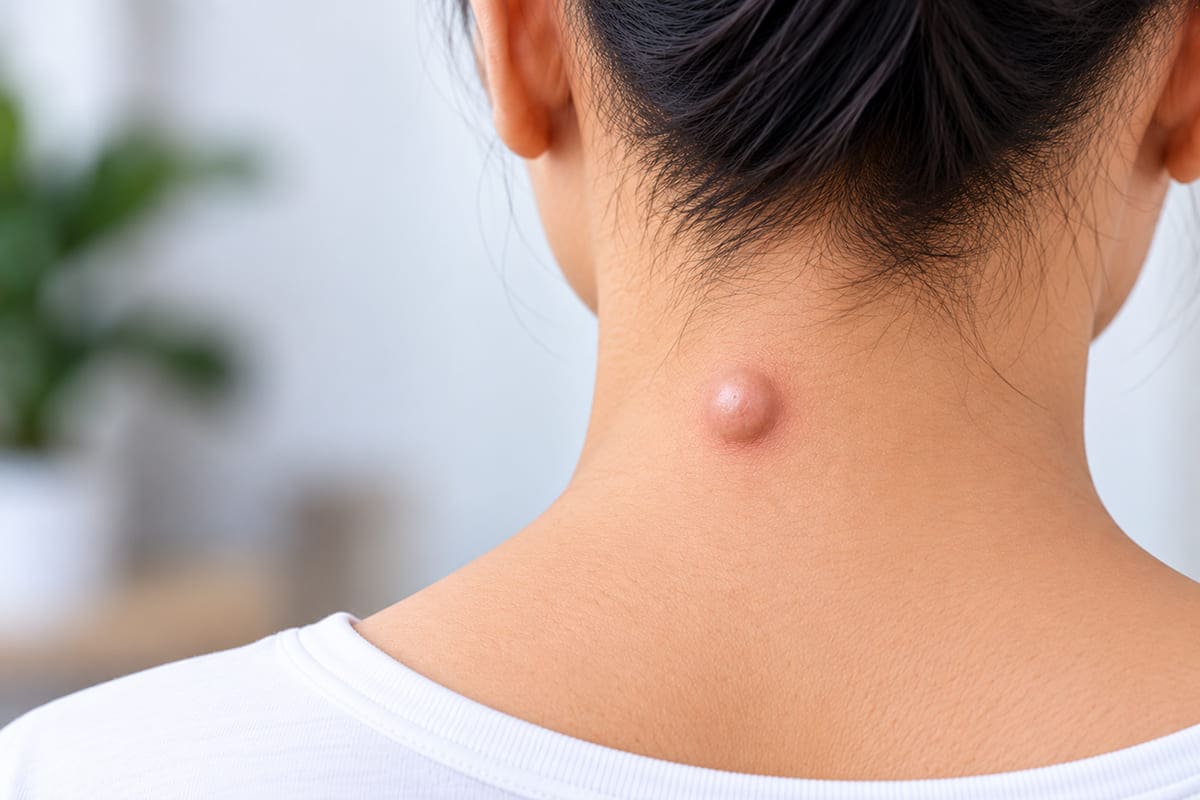

You notice a small, round bump under your skin one day — maybe while showering, maybe while getting dressed — and it wasn’t there a few months ago. It doesn’t hurt. It isn’t red. But it’s there, and now you’re wondering what it is and whether you need to do anything about it. In most cases, a lump like this is a harmless, slow-growing cyst — medically, usually an epidermoid cyst, though it’s commonly called a “sebaceous cyst.”
This article explains what these cysts are, what can happen if a bothersome one is left untreated, when removal may be worth considering, and what the surgical procedure actually involves — without exaggerating risk or promising outcomes that can’t be guaranteed.
What Is a Sebaceous or Epidermoid Cyst?
Most lumps that people call “sebaceous cysts” are, medically speaking, epidermoid cysts. They form when skin cells that would normally shed from the surface instead move deeper into the skin and accumulate, producing a sac filled with keratin (a natural skin protein) rather than the oily sebum that true sebaceous glands produce. The name “sebaceous cyst” has stuck around in everyday use, but true sebaceous-gland cysts are actually much less common.
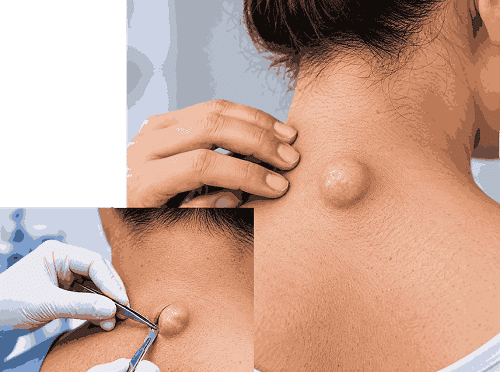
These cysts typically appear as small, round, slow-growing lumps, most often on the face, neck, scalp, back, or trunk, though they can occur elsewhere. Many have a tiny central opening, sometimes called a punctum, where the sac connects to the skin surface. Cysts are one of several common benign skin growths that tend to show up with age.
What Causes These Cysts?
The exact trigger isn’t always identifiable, but epidermoid cysts are generally understood to develop from:
● Blocked or damaged hair follicles or skin ducts
● Skin trauma, such as a cut, scratch, or previous acne lesion
● Normal skin-cell turnover being disrupted locally
In rarer cases, multiple cysts can be associated with certain inherited conditions, though this is uncommon and would typically be identified by a doctor rather than assumed by a patient.
What Are the Symptoms of a Cyst?
An uncomplicated cyst usually presents as:
● A small, round, firm-to-soft lump beneath the skin
● Slow growth over months or years
● A tiny central opening or punctum in some cases
● Usually painless and freely movable under the skin
Symptoms suggesting the cyst has become inflamed or infected include redness, tenderness, swelling, warmth, or drainage of thick, sometimes foul-smelling material.
When Does a Cyst Become Inflamed or Infected?
This distinction matters more than most patients realise, because it changes how — and when — a cyst should be managed.
● Uncomplicated cyst: Firm or soft, painless, slow-growing, with normal-looking skin over it.
● Inflamed cyst: The area becomes red, tender, and sometimes swollen, often after minor trauma or irritation, even without a true bacterial infection.
● Infected cyst: In addition to redness and swelling, there may be increasing pain, warmth, pus-like drainage, and sometimes fever if the infection is more extensive.
Only a clinical examination can reliably tell these apart, which is why a changing or uncomfortable cyst is worth having looked at rather than self-diagnosed.
What Happens If You Leave a Cyst Untreated?
This is one of the most common — and most misunderstood — questions patients have.
There is no single answer that applies to every cyst. Some uncomplicated cysts remain small and stable for years and may never cause a problem. Others may:
● Slowly enlarge over time
● Become inflamed after minor trauma or irritation
● Become infected, causing pain and drainage
● Rupture, releasing their contents into the surrounding skin
● Cause repeated discomfort or cosmetic concern if inflammation recurs
● Recur or persist if any earlier attempt at removal was incomplete
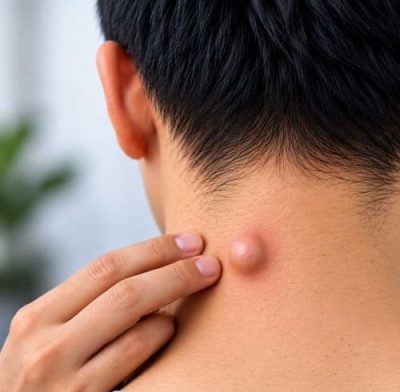
None of this means every untreated cyst will become a problem — many don’t. But because outcomes vary, observation may be reasonable for a small, stable, symptom-free cyst, while a cyst that is growing, recurrently inflamed, painful, or bothersome is generally better served by a proper clinical evaluation than by “waiting it out” indefinitely.
Can a Cyst Go Away on Its Own?
Sometimes, but it shouldn’t be assumed. A small inflamed cyst may settle down temporarily with time, but the underlying sac usually remains and can flare up again. Spontaneous, permanent resolution without any intervention is uncommon. If a cyst is persistent, enlarging, or repeatedly causing symptoms, it’s reasonable to have it assessed rather than wait indefinitely for it to disappear.
Should You Pop or Squeeze a Cyst?
No. Attempting to squeeze, puncture, or drain a cyst at home is discouraged, and for good reason. Because a cyst is essentially a sac with a wall (its capsule), squeezing it can rupture the sac without removing that wall — pushing cyst contents into the surrounding tissue. This can trigger:
● Inflammation or a secondary infection
● Increased pain and swelling
● Skin injury and a higher chance of visible scarring
● A cyst that’s more difficult to remove cleanly later, and more likely to recur
If a cyst is uncomfortable or concerning, a proper evaluation is a safer route than home attempts at drainage.
How Is a Cyst Diagnosed?
Diagnosis is usually clinical — based on medical history and a physical examination of the lump’s size, texture, mobility, and any central punctum. A dermatologist will also consider whether the lump could be something else, such as a lipoma (a soft fatty lump that typically doesn’t have a punctum) or a swollen lymph node, since these can sometimes resemble a cyst on casual inspection. Additional investigation is occasionally considered if the diagnosis is uncertain, though this isn’t routinely needed for a typical, straightforward cyst.
When Should a Cyst Be Removed?
Not every cyst needs surgery. Removal may be worth discussing with a dermatologist when a cyst:
● Is painful or tender
● Has become repeatedly inflamed
● Has become infected
● Is growing noticeably in size
● Has ruptured or drained previously
● Is in a location that gets repeatedly irritated (such as under clothing or a bra strap)
● Is causing cosmetic concern that bothers the patient
● Cannot be confidently distinguished from another type of lump without removal
If a cyst is small, stable, and not bothering the patient, continued observation is a legitimate option rather than an automatic path to surgery. Our doctors also perform mole removal and radiosurgery for other benign skin lesions, so if you’re unsure what your lump actually is, that’s a normal reason to come in.
Not sure if your lump needs removal or just watching?
A five-minute examination can usually tell an uncomplicated cyst apart from something that needs treatment.
Book an appointment with our dermatologists at Skin & Hair Surgery, Pune, and get a clear answer instead of guessing.
What Does Cyst Removal Surgery Involve?
Before the procedure: The dermatologist examines the cyst, confirms the diagnosis, and discusses the recommended approach along with expected healing and any risks specific to the case. Local anaesthesia is typically planned rather than general anaesthesia, since this is usually a minor outpatient procedure.
During the procedure: In general terms, the skin is cleaned and numbed with local anaesthesia, a small incision is made over the cyst, and the contents are removed. Where clinically possible, the surgeon also removes the cyst wall (capsule) itself, since leaving part of the capsule behind is the main reason cysts recur. The wound is then closed, often with sutures, and dressed.
After the procedure: Wound care instructions are given, along with guidance on monitoring for signs of infection, when to return for a follow-up, and when sutures (if used) will need to be removed.
If you’re weighing this option, the next step is a consultation to discuss what’s appropriate for your specific cyst — you can book an appointment online or call the clinic directly.
Can an Infected Cyst Be Removed Immediately?
Not always. When a cyst is actively inflamed or infected, the tissue planes around it can be harder to identify clearly, which makes complete removal of the capsule more difficult and can increase the chance of recurrence if attempted at that stage. In such cases, a dermatologist may first perform incision and drainage to relieve the acute infection, sometimes alongside antibiotics, and plan definitive removal of the cyst wall once the inflammation has settled. The right approach depends on the individual situation and is best decided after an in-person assessment.
Is Cyst Removal Painful?
Local anaesthesia is used to numb the area before the procedure, so most patients feel pressure or a brief pinch rather than sharp pain during the removal itself. Mild discomfort, tenderness, or soreness at the site afterward is common as the local anaesthetic wears off, and this varies from person to person. It would not be accurate to promise a completely pain-free experience for everyone.
How Long Does Cyst Removal Take?
Duration depends on the cyst’s size, depth, location, and whether it’s inflamed or straightforward. Many uncomplicated cysts can be removed in a relatively short outpatient visit, but there’s no single universal time that applies to every case — your dermatologist can give you a more specific estimate after examining the cyst.
Cyst Removal Recovery and Aftercare
Typical aftercare includes keeping the wound clean and dry as advised, following any dressing-change instructions, attending a follow-up visit, and having sutures removed if non-dissolvable stitches were used. Mild swelling or tenderness in the first few days is common. Contact your dermatologist if you notice increasing redness, pain, swelling, warmth, discharge, or fever, as these can indicate infection.
Does Cyst Removal Leave a Scar?
Any procedure that involves an incision carries some potential for a scar. How visible it ends up being depends on factors such as the cyst’s size and location, the technique used, how the wound is closed, individual healing tendencies, and how well aftercare instructions are followed. Scars often fade and become less noticeable over months, but no dermatologist can honestly promise a scar-free outcome for every patient.
Can a Cyst Come Back After Removal?
Recurrence is possible, particularly if any part of the cyst wall (capsule) is left behind, or if the cyst had previously ruptured or been inflamed, which can make the tissue planes harder to separate cleanly during removal. Complete removal of the capsule during surgery is the main factor associated with lower recurrence. If a cyst does return, a follow-up evaluation can help determine the most appropriate next step.
Have a cyst you'd like checked?
A cyst that’s growing, painful, or keeps flaring up is worth a proper look rather than a guess. Our dermatologists at Skin & Hair Surgery (Viman Nagar, Kothrud, and Aundh, Pune) can examine it, tell you whether removal is needed, and walk you through the procedure if it is.
Book an appointment or contact the clinic to get started.
Why Choose Skin & Hair Surgery Clinic for Skin Glowing Treatments in Pune?
At Skin & Hair Surgery Clinic, we offer personalized skin glow treatments tailored to your unique skin type and concerns. Our experienced dermatologists use advanced technologies and evidence-based procedures, including HydraFacial, chemical peels, laser rejuvenation, and skin brightening treatments, to help you achieve healthy, radiant skin. With a focus on safety, natural-looking results, and patient satisfaction, we strive to deliver effective solutions for long-lasting skin glow and rejuvenation.
FAQs
Not exactly. Most lumps commonly called “sebaceous cysts” are medically epidermoid cysts, filled with keratin rather than the sebum produced by true sebaceous glands. True sebaceous-gland cysts are much less common.
The vast majority of epidermoid cysts are benign. Malignant change within a cyst is considered very rare, but any lump that is rapidly growing, unusual in appearance, or otherwise concerning should still be examined by a dermatologist to confirm the diagnosis.
No. A small, stable, symptom-free cyst can reasonably be observed. Removal is generally considered when a cyst is painful, growing, repeatedly inflamed, infected, or bothersome to the patient.
There’s no reliable home remedy that resolves a cyst’s underlying sac. Warm compresses may ease mild irritation temporarily, but they don’t remove the capsule, so the cyst is likely to persist or return.
Squeezing or puncturing a cyst can push its contents into surrounding tissue, trigger inflammation or infection, injure the skin, and make later removal more difficult while increasing the chance of scarring and recurrence.
An infected cyst typically shows increasing redness, warmth, swelling, pain, and pus-like drainage, sometimes with fever, whereas an uncomplicated cyst is usually painless and unchanged in appearance over time.
Incision and drainage releases the fluid inside a cyst but leaves the capsule behind, so the cyst can return. Surgical excision removes the cyst along with its capsule, which is associated with a lower chance of recurrence.
For most uncomplicated cysts, removal is a minor outpatient procedure performed under local anaesthesia, not major surgery requiring hospital admission.
It can, especially if part of the capsule remains or the cyst was previously ruptured or infected before removal. Complete capsule removal lowers, but doesn’t eliminate, this possibility.
This depends on the size and location of the cyst and the technique used. Your dermatologist will give you specific guidance based on your procedure.
Yes, both can present as lumps under the skin, but a lipoma is typically softer, doesn’t have a central punctum, and behaves differently on examination. A clinical assessment can distinguish between the two.
It’s reasonable to seek an evaluation if a lump is growing, painful, changing in appearance, draining fluid, recurring after previous treatment, or simply causing you concern.
Whether your cyst is small and stable or has become painful, inflamed, or infected, the safest first step is an in-person evaluation — not guessing from photos online or attempting to drain it yourself.
Book a consultation with our dermatologists at Skin & Hair Surgery, Pune, and get a clear, honest plan for your specific case.