
The breakouts settled down months ago, yet the mirror still shows the evidence: small pits on the cheeks, shallow dents near the temples, or skin that looks uneven when the light hits it from the side. For many people, what acne leaves behind is more frustrating than the acne itself.
Here is something many people don’t realise: not every mark left by acne is a scar.
● A flat brown or dark spot is usually post-inflammatory hyperpigmentation (PIH), extra pigment produced after inflammation. It is especially common in Indian skin tones.
● A flat red or pink patch is often post-inflammatory erythema (PIE), caused by small blood vessels that stay dilated after a breakout.
●A true acne scar changes the skin’s structure, leaving a pit, a dent or a raised bump.
Even true scars come in several types, sitting at different depths and responding to different treatments. So the useful question isn’t “what is the best acne scar treatment?” It is: which acne scar treatment is right for my scars and my skin? This guide explains how dermatologists answer that question.
What Are Acne Scars?
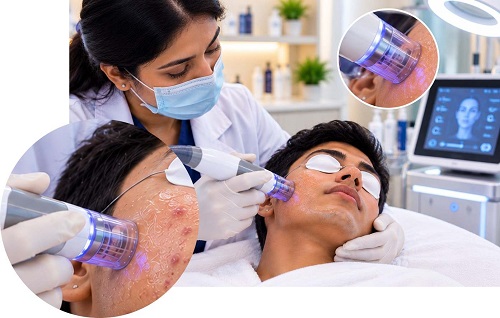
Acne scars form when inflammation from a pimple, nodule or cyst damages the deeper layer of the skin, called the dermis. As the skin heals, it rebuilds collagen, the protein that gives skin its structure. When too little collagen is rebuilt, the skin sinks and a depressed (atrophic) scar forms. When too much is produced, the scar becomes raised.
Deep, painful acne (nodules and cysts), picking or squeezing pimples, and delaying treatment all raise the risk of scarring. That is why controlling active acne early is one of the most effective ways to prevent new scars.
| Skin Concern | What It Looks Like | Is It a True Scar? | Typical Treatment Approach |
|---|---|---|---|
| Dark acne marks (PIH) | Flat brown, grey or dark patches | No | Sun protection, topical treatments, selected chemical peels |
| Red acne marks (PIE) | Flat red or pink spots | No | Time, gentle skincare, vascular laser in selected cases |
| Depressed (atrophic) scars | Pits, dents or wavy texture | Yes | Procedures that rebuild collagen or release tethered skin |
| Raised scars | Firm bumps above the skin surface | Yes | Injections, silicone products, other scar-flattening methods |
Different Types of Acne Scars
Most acne scars are atrophic, meaning they sit below the surrounding skin. Dermatologists usually describe three main types, and many people have more than one.
1. Ice Pick Scars
Ice pick scars are narrow, deep holes that look as though the skin was punctured with a sharp tool. They are usually less than 2 mm wide at the surface but can extend deep into the dermis, narrowing like a V.
They are often the hardest scars to improve, because surface treatments cannot reach their base. A dermatologist may consider TCA CROSS (a focused chemical technique) or, for selected scars, punch excision, in which the scar is removed and the skin closed. Resurfacing may follow to blend the texture.
2. Boxcar Scars
Boxcar scars are round or oval depressions with sharp, well-defined edges, a bit like small craters. They are wider than ice pick scars and commonly appear on the cheeks and temples.
Depth matters here:
● Shallow boxcar scars may respond to fractional laser resurfacing, microneedling or, in some cases, chemical peels.
● Deeper boxcar scars may need focused techniques such as TCA CROSS or punch elevation, often combined with resurfacing.
3. Rolling Scars
Rolling scars are wider, shallow depressions with soft, sloping edges, giving the skin a wavy or uneven look. They are often more visible in side lighting.
The cause is tethering: fibrous bands beneath the skin pull the surface down towards deeper tissue. Because the problem sits under the skin rather than on it, resurfacing alone may give limited results. A dermatologist may first consider subcision to release those bands, followed by collagen-stimulating treatments. Fillers may be used for selected cases.
Important Read: Sculptra vs Dermal Fillers – Which Anti-Aging Treatment Lasts Longer? A closer look at how injectable fillers work, which helps if fillers are being considered for rolling scars.
4. Raised Acne Scars (Hypertrophic and Keloid Scars)
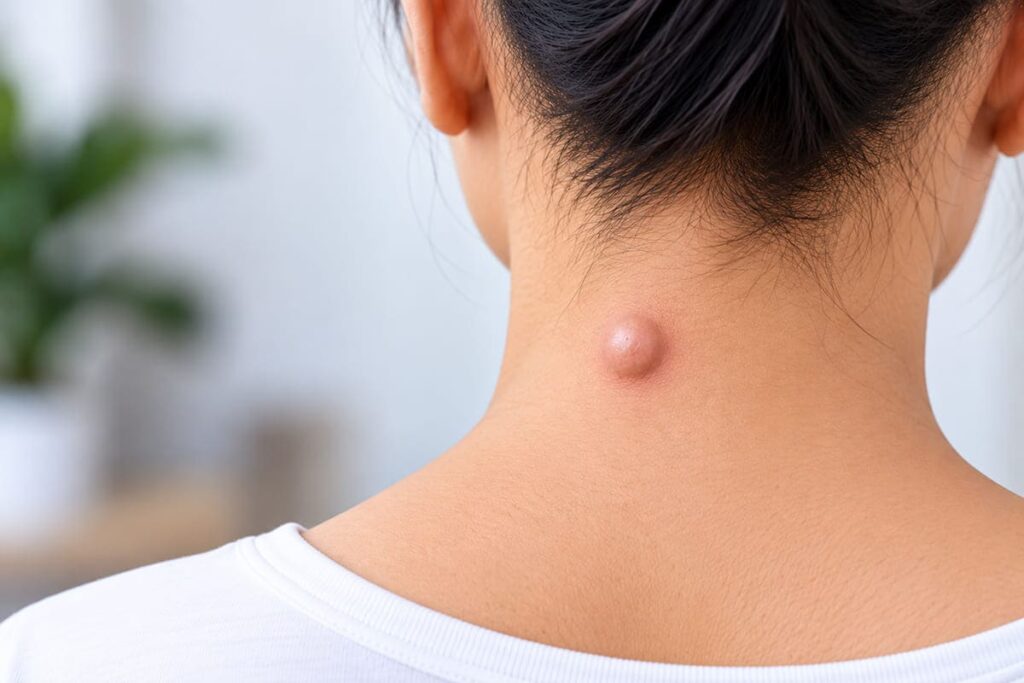
Raised scars form when the skin produces too much collagen during healing. Hypertrophic scars stay within the boundary of the original pimple. Keloids grow beyond it and may itch or feel tender. They are more common on the jawline, chest, shoulders and back, and some people are more prone to them.
Raised scars need a completely different approach from pitted ones. Options may include steroid injections into the scar, silicone gels or sheets, cryotherapy or certain lasers. Some procedures used for pitted scars could aggravate keloid-prone skin, which is one reason assessment matters.
Acne Marks vs Acne Scars: How Are They Different?
Are acne marks the same as acne scars? No. Marks are colour changes on a smooth skin surface. Scars are changes in the skin’s structure.
How do I know if I have acne scars? Run a finger over the area and look at it under side lighting. If the spot is flat and only discoloured, it is likely a mark. If it is dented, pitted or raised, it is likely a scar. Many people have both, and a dermatologist can confirm which is which.
Do acne marks go away? Often, yes. PIH and PIE usually fade gradually over months, especially with daily sun protection. In darker skin, dark marks can take longer and may darken further with sun exposure or irritation.
The difference changes the treatment. Pigment needs approaches that calm inflammation and regulate melanin. An indentation is a loss of structural support, so it needs collagen to be rebuilt or tethered skin to be released. A brightening serum cannot fill a pit, and an aggressive procedure is unnecessary for a flat mark that may fade on its own.
Can acne scars be removed completely? Usually not entirely, but they can often be improved noticeably. More on this below.
Important Read: If your concern is mainly flat dark or red spots rather than pits, see our guide to acne marks treatment, which explains how dermatologists approach post-acne pigmentation.
Acne Scar Treatment Options
The treatments below are used by dermatologists in different combinations. None is the “best” for everyone; each suits certain scars and skin types better than others.
Microneedling
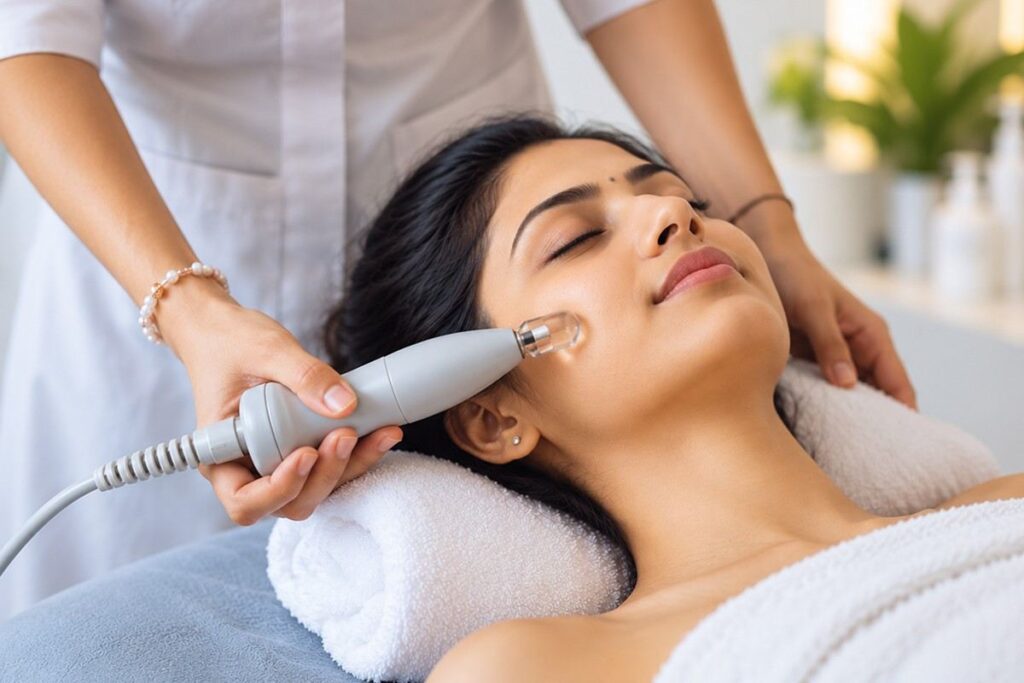
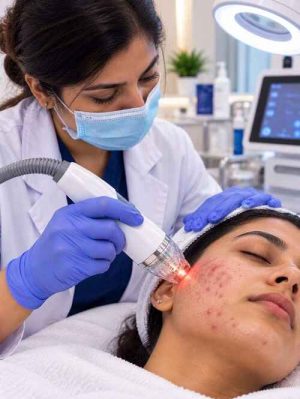
Microneedling uses fine needles to create controlled micro-injuries in the skin, prompting it to produce new collagen. Radiofrequency microneedling adds heat to deepen this effect.
May be considered for: rolling scars and shallow boxcar scars.
● Advantages: generally well tolerated across skin tones, with relatively short downtime.
● Limitations: usually modest effect on deep ice pick scars; gradual results over several sessions.
Fractional Laser / Fractional Resurfacing
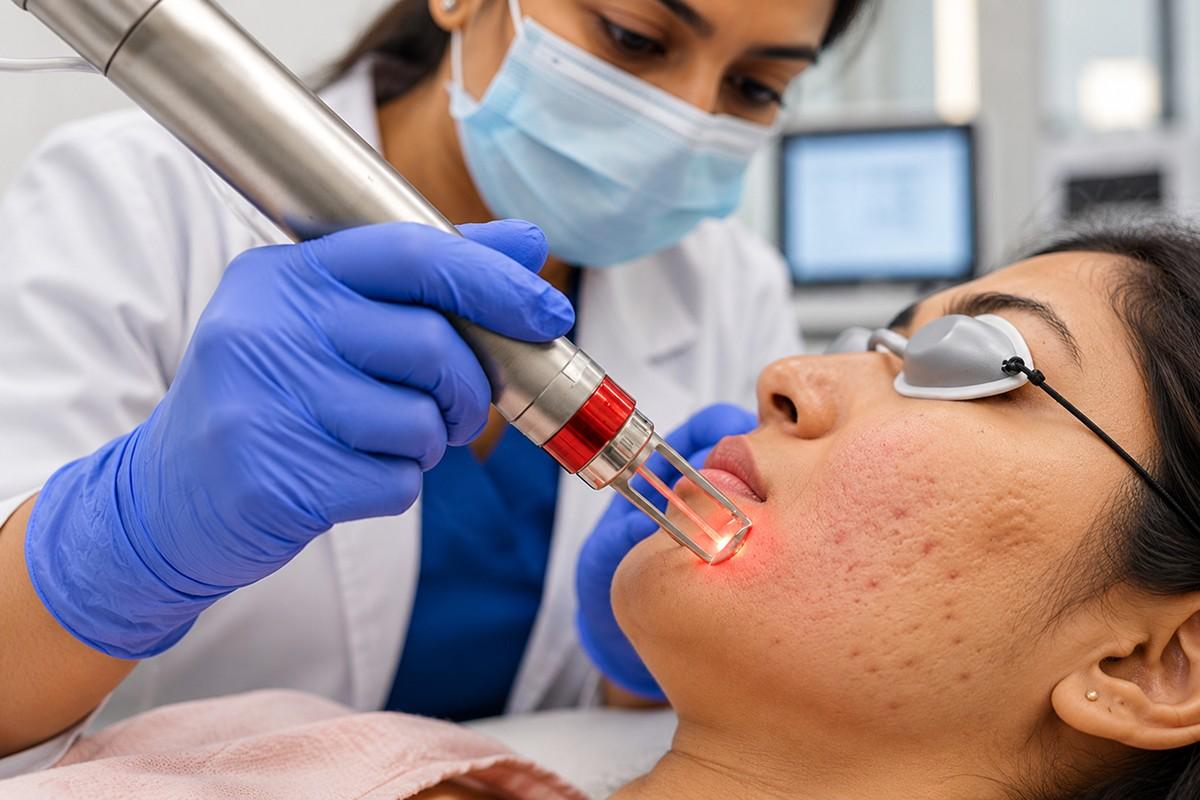
Fractional lasers treat tiny columns of skin while leaving the surrounding skin intact, which speeds healing and stimulates collagen. Ablative lasers (such as fractional CO2) work more deeply; non-ablative lasers are gentler.
● May be considered for: boxcar scars, rolling scars and overall uneven texture.
● Important for Indian skin: darker skin carries a higher risk of post-inflammatory pigmentation after laser. Dermatologists may adjust laser settings, prepare the skin beforehand and plan sun protection carefully.
Subcision
Subcision is a minor procedure where a special needle is inserted under the scar to cut the fibrous bands pulling it down. Once released, the skin can lift and new collagen can form beneath it.
● May be considered for: rolling scars and some tethered boxcar scars.
● Not suitable for: ice pick scars or raised scars. Temporary bruising and swelling are common.
Chemical Peels
Chemical peels apply an acid solution to remove outer layers of skin in a controlled way.
● Can help with: dark acne marks, dullness and mild surface texture.
● Limitations: superficial peels are unlikely to improve deep structural scars on their own. Deeper peels need careful selection, especially in darker skin.
Important Read: Chemical Peel Treatment: the types of peels available and who they may suit.
TCA CROSS
TCA CROSS (Chemical Reconstruction of Skin Scars) involves applying a high-strength trichloroacetic acid precisely into the base of individual scars. This triggers collagen production inside the scar.
● May be considered for: ice pick scars and narrow, deep boxcar scars.
● Why evaluation matters: the acid used is far stronger than any home product. Incorrect use can cause pigment changes or worsen scarring, so it should be performed only by a dermatologist.
PRP and Combination Approaches
PRP (platelet-rich plasma) uses growth factors from the patient’s own blood. It is generally used as an add-on to microneedling or laser, with the aim of supporting healing, rather than as a standalone scar treatment. Evidence for its benefit is still developing.
In practice, many treatment plans combine methods, because most people have more than one scar type.
Which Treatment Is Suitable for Which Acne Scar?
This table summarises approaches that dermatologists commonly consider. It is a guide, not a diagnosis.
| Acne Scar Type | Common Characteristics | Treatment Options That May Be Considered | Important Considerations |
|---|---|---|---|
| Ice Pick | Deep, narrow pits, usually under 2 mm wide | TCA CROSS, punch excision, followed by resurfacing | Surface-only treatments often have limited effect |
| Boxcar | Round or oval depressions with sharp edges | Fractional laser, microneedling, TCA CROSS or punch elevation for deeper scars | Depth decides the approach |
| Rolling | Wide, wavy depressions caused by tethering | Subcision, then microneedling or laser; fillers in selected cases | Releasing tethering is often the first step |
| Raised scars | Firm, elevated scar tissue | Steroid injections, silicone products, cryotherapy, certain lasers | Resurfacing methods for pitted scars may be unsuitable |
| Pigmented marks | Flat dark or red discolouration | Sun protection, topical treatments, chemical peels, vascular laser for red marks | Not a structural scar; often fades with time |
Can One Person Need More Than One Acne Scar Treatment?
Yes, and it is very common. A single face may have:
● Rolling scars on the cheeks alongside boxcar scars on the temples
● Deep scars together with dark post-acne pigmentation
● Active acne still forming while older scars remain
● Uneven texture combined with post-inflammatory marks
Each of these concerns responds to a different method. A dermatologist may plan treatments in stages, such as controlling active acne first, then releasing tethered scars, then resurfacing, while managing pigmentation throughout. The plan is built around the individual, not a fixed protocol.
How Does a Dermatologist Decide Which Acne Scar Treatment You Need?
A dermatologist for acne scars looks at much more than how the scars appear. Typical considerations include:
1. Scar type: ice pick, boxcar, rolling, raised, or a mix.
2. Scar depth: shallow scars and deep scars need different tools.
3. Skin type and tone: darker skin needs extra care to reduce the risk of pigmentation after procedures.
4. Active acne: ongoing breakouts usually need control before scar procedures.
5. Pigmentation: existing PIH or PIE may need parallel treatment.
6. Previous procedures: what has been tried, and how the skin responded.
7. Medical history: including medications, healing problems and any tendency to keloids. If you are taking or have recently stopped isotretinoin, your dermatologist will advise on procedure timing.
8. Skin sensitivity: how reactive the skin is to irritation.
9. Downtime: how much recovery time fits your work and life.
10. Your goals: what improvement would feel meaningful to you.
Get a personalised acne scar assessment in Pune
At Skin & Hair Surgery, every acne scar treatment plan starts with an in-person evaluation of your scar types, skin tone, active acne and goals, so the treatment is chosen for your skin rather than taken off a menu.
Visit us at Viman Nagar, Kothrud or Aundh. Book Your Appointment or call +91 90966 94007.
How Many Sessions Are Needed for Acne Scar Treatment?
There is no fixed number. It depends on scar severity, scar type, the treatment chosen, how your skin responds and whether treatments are combined. Some focused procedures, such as subcision or TCA CROSS, may be repeated for certain scars, while microneedling and laser are typically done as a series spaced several weeks apart.
Acne scar improvement is usually a process rather than a one-time procedure. The same factors also shape acne scar treatment cost, which is best understood after an assessment, once the number and type of sessions are clearer.
How Long Does Acne Scar Treatment Take to Show Results?
Some changes, such as smoother texture after resurfacing, may be noticed within weeks once the skin has healed. Deeper improvement takes longer because new collagen forms and remodels gradually, over several months after each session.
This is why patience matters. Results tend to build with each session, and the final effect of a treatment course is usually judged some months after it ends.
Can Acne Scars Be Completely Removed?
In most cases, acne scars cannot be completely erased. Acne scar treatment generally aims to improve the appearance, texture and visibility of scars rather than promise complete elimination.
That said, meaningful improvement is often possible. Many people find their scars become shallower, softer and far less noticeable, which can make a real difference to confidence. Being realistic from the start helps you choose treatments wisely and judge results fairly.
What Should You Avoid When Treating Acne Scars?
To protect your skin and avoid new damage:
● Don’t pick or squeeze pimples. It deepens inflammation and raises the risk of new scars.
● Avoid aggressive DIY procedures, including home dermarollers with long needles or at-home “laser” devices used without guidance.
● Don’t use strong acids without supervision. High-strength peels can burn the skin and cause dark patches.
● Be cautious with unverified home remedies. Lemon juice, toothpaste or baking soda can irritate skin and worsen pigmentation.
● Don’t layer many active products at once. Combining several exfoliants and retinoids can damage the skin barrier.
● Avoid procedures without proper assessment. A treatment suited to someone else’s scars may not suit yours.
Good skincare still has a role: gentle cleansing, moisturising and daily sunscreen support healthy skin and help marks fade.
Important Read: How Modern Techniques Help Reduce Deep Acne Scars:
When Should You See a Dermatologist for Acne Scars?
It may be worth booking a consultation if you have:
● Depressed scars that have persisted for months or years
● Deep pitted or ice pick scars
● Raised, itchy or growing scars
● Significant dark or red marks that are not fading
● New scars forming despite acne treatment
● Recurrent breakouts that keep leaving marks
● Little improvement after home care
● Uncertainty about which type of scar you have
● Interest in laser, microneedling, subcision or other procedures
Acne scars are not one condition, and they rarely respond to a single, one-size-fits-all treatment. At Skin & Hair Surgery, our dermatology team begins with a detailed assessment of your scar types, skin tone and goals, then recommends a personalised acne scar treatment plan that suits your skin. If your scars have been bothering you, a consultation is a good first step towards understanding your options.
Acne Scar Treatment Comparison Table
A treatment-first view of the same decision, suited to a standalone infographic or a sidebar block. The scar-first table sits inside the article.
| Treatment | How It Works | Scars It May Suit | Less Suitable For | Key Consideration |
|---|---|---|---|---|
| Microneedling / RF microneedling | Micro-injuries stimulate new collagen | Rolling, shallow boxcar, general texture | Deep ice pick, raised scars | Gradual results over a series of sessions |
| Fractional laser | Treats tiny columns of skin to remodel collagen | Boxcar, rolling, uneven texture | Raised/keloid-prone scars | Settings and skin prep adjusted for darker skin to limit pigmentation |
| Subcision | Needle releases fibrous bands under the scar | Rolling, tethered boxcar | Ice pick, raised scars | Temporary bruising and swelling |
| Chemical peels | Controlled removal of outer skin layers | Dark marks, mild surface texture | Deep structural scars (alone) | Strength chosen to skin type |
| TCA CROSS | High-strength acid applied into individual scars | Ice pick, narrow deep boxcar | Wide rolling scars | Dermatologist-only; risk of pigment change if misused |
| Punch excision / elevation | Scar removed or lifted surgically | Deep ice pick, deep boxcar | Wide or numerous shallow scars | Minor surgical procedure |
| Steroid injections / silicone | Flatten and soften excess scar tissue | Hypertrophic and keloid scars | Pitted scars | Keloids may need ongoing management |
| PRP (adjunct) | Growth factors from the patient's blood | Used alongside microneedling or laser | As a standalone scar treatment | Evidence still developing |
Why Choose Skin & Hair Surgery Clinic for Skin Glowing Treatments in Pune?
At Skin & Hair Surgery Clinic, we offer personalized skin glow treatments tailored to your unique skin type and concerns. Our experienced dermatologists use advanced technologies and evidence-based procedures, including HydraFacial, chemical peels, laser rejuvenation, and skin brightening treatments, to help you achieve healthy, radiant skin. With a focus on safety, natural-looking results, and patient satisfaction, we strive to deliver effective solutions for long-lasting skin glow and rejuvenation.
FAQs
There is no single best treatment for every acne scar. The right option depends on scar type, depth and skin tone. Rolling scars often benefit from subcision, ice pick scars from TCA CROSS or punch techniques, and boxcar scars from resurfacing; many people need a combination.
Ice pick scars are usually treated with focused techniques such as TCA CROSS or punch excision, because they are too deep and narrow for surface treatments alone. Resurfacing may follow to smooth the overall texture.
Yes, microneedling can improve rolling and shallow boxcar scars by stimulating new collagen. It usually works gradually over several sessions and has limited effect on deep ice pick scars.
Fractional laser treatment can improve boxcar and rolling scars and overall texture in suitable patients. In Indian skin tones, settings and aftercare need careful planning to reduce the risk of dark marks after treatment.
Subcision is often considered for rolling scars because it releases the fibrous bands that pull the skin down. It is frequently combined with microneedling or laser for further improvement.
Chemical peels are most useful for dark acne marks and mild surface texture. On their own, superficial peels are unlikely to significantly improve deep pitted scars.
Yes, deep acne scars can often be improved, usually with a combination of methods such as TCA CROSS, punch techniques, subcision and resurfacing. Complete removal is uncommon, but visible improvement is often achievable.
Narrow deep holes suggest ice pick scars, sharp-edged craters suggest boxcar scars, and wide wavy dents suggest rolling scars. Many people have a mix, so a dermatologist’s examination is the most reliable way to know.
Acne scars usually cannot be removed completely, but treatment can make them shallower and much less noticeable. The aim is improvement in texture and visibility rather than total elimination.
It varies with scar severity, scar type and the treatment used. Most people need a series of sessions spaced weeks apart, and the number is best estimated after an assessment.
No. Acne marks are flat colour changes (brown or red) that often fade with time. Acne scars are changes in skin texture, such as pits or raised bumps, and usually need procedures to improve.
Shallow boxcar scars may respond to fractional laser or microneedling. Deeper boxcar scars may need TCA CROSS or punch elevation, often followed by resurfacing.
Rolling scars are often treated with subcision to release tethering, followed by microneedling or fractional laser. Fillers may be considered in selected cases.
Improved scars do not usually return, but new acne can create new scars. Keeping active acne under control helps protect the results of treatment.
Yes, in most cases. Active acne is usually controlled first, so new breakouts don’t undo progress and the skin is less inflamed during procedures. Your dermatologist may advise on timing, especially if you are on acne medication such as isotretinoin.